Showing posts with label peace. Show all posts

Saturday, September 04, 2021

Barefoot Gen Volume One A Cartoon Story of Hiroshima by Keiji Nakazawa

Keiji Nakazawa's semi-autobiographical Japanese comic book series Hadashi no Gen has been translated as Barefoot Gen in a 10-volume series. I read Volume 1, and I have immediately requested Volume 2 from my public library. 

Sometimes it's hard for me to sit in a social gathering listening to "normal" conversation when I think that humans have accumulated enough nuclear weapons to destroy themselves hundreds of times over. I hope I never lose that anxiety, and I don't understand people who are blasé about how close we are to destruction at our own hands.

Saturday, December 17, 2016

Review: Armageddon in Retrospect by Kurt Vonnegut

This collection of short stories by the American writer Kurt Vonnegut reflect his visceral disgust at war, which developed during his World War II experience as a prisoner of war disposing of the corpses left after the British and United States air forces destroyed Dresden in February of 1945. I'd read two of his novels, Slaughterhouse Five and Cat's Cradle, a long time ago. Slaughterhouse Five has been made into a movie.

In any short story collection, each reader will like some and dislike some. My favorites were "Great Day" and "The Commandant's Desk." The style, in its satirical humor, reminded me of Mark Twain, who opposed United States imperialism.

Wednesday, April 08, 2015

Everyday Iran on Twitter, Instagram & Facebook

As elements of the United States government continue to press for war with Iran, perhaps the most effective action for peace is to remind people everywhere that the victims of war will overwhelmingly be everyday Iranians, not the stereotyped, cartoonish villains whom warmongers portray with their rhetoric. For this purpose, I ask people to follow and share the pictures of Everyday Iran on Twitter and Instagram and Facebook.

Thursday, November 06, 2014

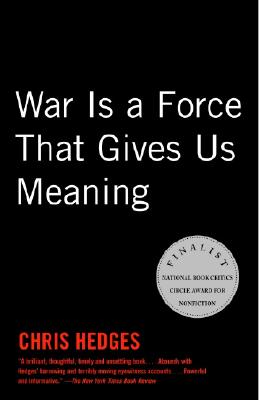
Quote: Chris Hedges on Friendship and Comradeship in "War is Force that Gives Us Meaning"

In War Is a Force That Gives Us Meaning, Chris Hedges (Twitter) explains why the bonds among soldiers are likely comradeship, not friendship.

There are few individual relationships – the only possible way to form friendships – in war. There are not the demands on us that there are in friendships. Veterans try to regain such feelings, but they fall short. Gray wrote that the “essential difference between comradeship and friendship consists, it seems to me, in a heightened awareness of the self in friendship and in the suppression of self-awareness in comradeship.”
Comrades seek to lose their identities in the relationship. Friends do not. “On the contrary, “Gray wrote, “friends find themselves in each other and thereby gain greater self-knowledge and self-possession. They discover in their own breasts, as a consequence of their friendship, hitherto unknown potentialities for joy and understanding.”
The struggle to remain friends, the struggle to explore the often painful recess of two hearts, to reach the deepest parts of another’s being, to integrate our own emotions and desires with the needs of the friend, are challenged by the collective rush of war. There are fewer demands if we join the crowd and give our emotions over to the communal crusade.
The only solace comes from simple acts of kindness. They are the tiny, flickering candles in a cavern of darkness that sustain our common humanity.
Find the book in your local library.

Saturday, March 15, 2014

Saturday, November 03, 2012

Wednesday, September 05, 2012

Review: Hiroshima by John Hersey

John Hersey's first version of Hiroshima was published in 1946. This edition included updates on the six survivors he had originally profiled and was published in 1985. It is available through Georgia PINES-participating libraries.
 
Regular readers of this blog know that I am completely appalled by the atomic bombings of Hiroshima and Nagasaki and I see no purpose for any nation or group, particularly one claiming to follow Islam, to possess such weapons.

Perhaps the only thing more depressing than the desperate testimonials of these six survivors is how the author interspersed, as the years went by in the lives of the survivors, landmarks in the spread and development of the world's nuclear arsenal, such as the development of the hydrogen bomb and Indian proliferation. Some survivors tried to educate the world on Hiroshima's lesson, namely that humans must end war. Sadly, the world has so far refused to listen.

Monday, March 12, 2012

Review: Teach Us to Live: Stories from Hiroshima and Nagasaki by Diana Wickes Roose

This book can be ordered from Intentional Productions.

Listen to the CD accompanying this book with the recordings of translated testimonies of survivors of the atomic bombings of Hiroshima and Nagasaki. I hope no Muslim ever uses the term "Islamic bomb." There's nothing "Islamic" about the bomb, and we should work towards complete nuclear disarmament.

P.S. If you get a chance, watch David Rothauser's Hibakusha, Our Life to Live.