Khadra Shamy, the protagonist, is the daughter of Wajdy & Ebtehaj, Syrian immigrants who eventually move to a town south of Indianapolis, Indiana to work at the Dawah Center. There, they and their co-workers work to realize the ideal Muslim community and raise their children to carry on that legacy after them. Khadra suffers some abuse from prejudiced classmates at the public school and neighbors in the apartment complex, but, for the most part, she grows into the young woman which the leaders of the Dawa Center envisioned: She prays, reads Quran, supports causes of Muslims suffering around the world and scrupulously upholds the interpersonal morals and gender roles of the community.
Monday, November 08, 2021
Review: "The Girl in the Tangerine Scarf" by Mohja Kahf
Tuesday, February 23, 2021
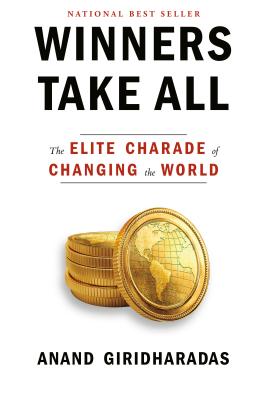
Comments on "Winners Take All: The Elite Charade of Changing the World" by Anand Giridharadas
MarketWorld is an ascendant power elite that is defined by the concurrent drives to do well and do good, to change the world while also profiting from the status quo. It consists of enlightened businesspeople and their collaborators in the worlds of charity, academia, media, government and think tanks. It has its own thinkers, whom it calls thought leaders, its own language, and even its own territory -- including a constantly shifting archipelago of conferences at which its values are reinforced and disseminated in translated into action. MarketWorld is a network and community but it is also a culture and state of mind.
These elites believe and promote the idea that social change should be pursued principally through the free market and voluntary action, not public life and the law and the reform of the systems that people share in common; that it should be supervised by the winners of capitalism and their allies and not be antagonistic to their needs; and that the biggest beneficiaries of the status quo should play a leading role in the status quo's reform. [p. 30]
Wednesday, November 12, 2014
Review: "How Big is Allah?" by Emma Apple
Tuesday, January 21, 2014
Review: Thomas Jefferson’s Qur’an: Islam and the Founders by Denise Spellberg

Orme Wilson, director and immediate past president of The Filson Historical Society, reviewed this book for The Courier-Journal, a Louisville, Kentucky newspaper.
I have not read the book.
Thursday, September 19, 2013
Friday, June 14, 2013
Spiritual Gems of Islam by Jamal Rahman
Frederic and Mary Ann Brussat reviewed Spiritual Gems of Islam: Insights & Practices from the Qur'an, Hadith, Rumi & Muslim Teaching Stories to Enlighten the Heart & Mind by Jamal Rahman. I have not read the book.With enthusiasm and authenticity, the author taps into the wisdom of Islam with insights and practices from the Qur'an, Hadith (the sayings of the Prophet Muhammad as well as the hadith qudsi, which are God's words communicated through the Prophet), the 14th century Sufi poet Rumi, and Muslim teaching stories. Read more ...
Wednesday, June 12, 2013
Review: The Search for Truth about Islam: A Christian Pastor Separates Fact from Fiction by Ben Daniel

Rachel Magruder at The United Methodist Reporter reviewed The Search for Truth about Islam: A Christian Pastor Separates Fact from Fiction by Ben Daniel . I have not read the book.
Saturday, May 25, 2013
Review: The Duties of Brotherhood in Islam by al-Ghazali, translated by Muhtar Holland
Friday, May 17, 2013
Review: Light Without Fire: The Making of America’s First Muslim College
I have not read the book.
H/t to Ebadur Rahman
Caffeinated Muslim: Review of “Light Without Fire: The Making of America’s First Muslim College” ow.ly/2wW7b9
— Ebadur Rahman (@i_baad) May 17, 2013
Wednesday, May 15, 2013
Wednesday, May 08, 2013
Golden Domes and Silver Lanterns: A Muslim Book of Colors by Hena Khan and Mehrdokht Amini

Lori Norman of StoryQuill reviewed Golden Domes and Silver Lanterns: A Muslim Book of Colors by Hena Khan and illustrated by Mehrdokht Amini. You can like Hena Khan's Facebook page.
Lori Norman is on Twitter.
I have not read the book.
The Myth of the Muslim Tide: Do Immigrants Threaten the West?

Gene Bedient reviewed The Myth of the Muslim Tide: Do Immigrants Threaten the West? by Doug Sanders (Twitter) at Prairie Fire (Twitter).
What Turns Some Western Muslims into Terrorists? The Causes of Extremism, an excerpt from Chapter 2 of this book, has been published at Doug Sanders's blog.
I have not read the book.
Living Shrines of Uyghur China by Lisa Ross

Ian Johnson reviewed Friends of God: Sufi Shrines in Western China by Lisa Ross in The New York Review of Books. Some photos are on exhibit at the Rubin Museum of Art in New York through July 8, 2013.
NPR also published a piece about the book, with some photos. La Journal de La Photographie also published an introduction to Lisa Ross's work, and it has some pictures as well. There's also an article in The Wall Street Journal. Lisa Ross also participated in a Rubin Museum of Art podcast episode (iTunes).
If you are in NYC, you can meet her for lunch today, May 8, at 1:00 PM.
I have not read the book. Hat tip to Omar Sacirbey, editor of Moozweek.
Friday, April 19, 2013
Play: "Disgraced" by Ayad Akhtar
I have not seen the play. H/t
- ‘Disgraced,’ by Ayad Akhtar, With Aasif Mandvi - NYTimes.com ow.ly/2wgzbc
— Ebadur Rahman (@i_baad) April 18, 2013
Tuesday, April 16, 2013
Book Review: Christians, Muslims and Jesus by Mona Siddiqui

Stuart Kelly reviewed the book at Scotsman.com. Sameer Rahim reviewed it at The Telegraph.
I have not read the book.
Here is a recording of a lecture she gave at Edinburgh University in Scotland on March 11, 2013.
Thursday, March 28, 2013
Saturday, March 23, 2013
Review: The Creation: An Appeal to Save Life on Earth by E.O. Wilson
This book is a Reader's Digest version of Professor Wilson's ideas as expressed in books like Future of Life and Social Conquest. It's meant to spread biophilia among the religious to get humanity in action to save biodiversity. Bill Moyers's 2006 show Is God Green? addresses some of this as well.
I thought that the most interesting part of the book was Wilson's explanation of biology as a discipline and how love of this branch of science could be inculcated in students, pages 103-61.
Review: The Social Conquest of Earth by Edward O. Wilson
The bulk of this book describes the process by which Homo sapiens' ancestors became eusocial and how that led to multilevel selection. When a species becomes eusocial, group selection becomes an important element in the species' evolution.
For criticism of the concept of group evolution, read blog entry 1 and blog entry 2 from Jerry Coyne, the author of Why Evolution is True, a book I have in my possession and intend to read and review. I heard Dr. Coyne give a lecture in a suburb of Augusta, GA on February 4, 2013.
Being an expert in insects, the typical example of eusociality, E.O. Wilson shifts back and forth between describing the development of eusociality in ants and eusociality in anthropods.
The important thing for me, and for most readers of this blog, is Professor Wilson's final chapters where he presents conclusions on how this understanding of humanity should impact our religious and moral beliefs and ethical practices.
Thursday, March 21, 2013
Review: Anthill by E.O. Wilson

This fiction book presents themes Professor Wilson has emphasized in his nonfiction books. The most important theme is the necessity of creative synthesis of capitalism and environmental protection. The lead character, Raphael Cody, learns that a beloved southern Alabama old wood forest surrounding a lake will be threatened by Mobile's expansion. In fact, his blue-blood maternal uncle is among the business elite advocating this development. Raphael leaves the study of the biosphere to complete a law degree at Harvard. Upon graduation, he returns and works as the legal counsel for the developer who purchased the property and who has previously converted woodland and wetlands to suburban Mobile sprawl. As legal counsel, he is able to develop a proposal which to a large extent preserved the quality of the land while advancing his employer's bottom line.
Monday, March 11, 2013
Review: Minaret by Leila Aboulela

Professor Heather Abdelnur reviewed Minaret by Leila Aboulela.
As the movement goes from late teen’s mini-skirt wearing, callous, and shallow rich girl, to an increasingly religious and conservative working class woman, Aboulela could have made the transformation too fast, too unbelievable, or too cliche. Instead, the reader believes the changes, comes to understand the transformation of character, and, while wishing for a happy ending that might not come, we do not pity Najwa nor exhault her. ... read more ...Dr. Abdelnur has reviewed other books.